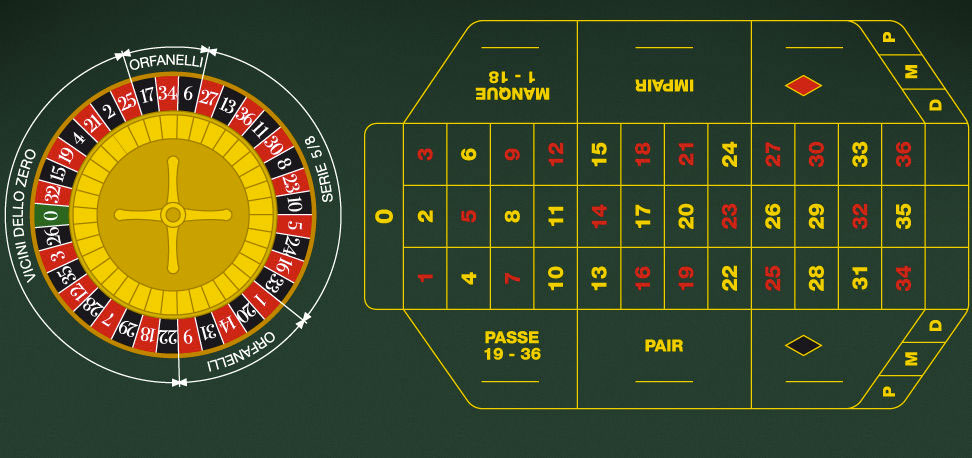
The table (table de jeu) is rectangular and the top is covered almost completely with green baize (tapis verte) on which the grid (tableau) is drawn. The grid is made up of numbers, columns, sixlines and simple combinations.
The roulette is positioned at one end of the table. This consists of a wooden wheel (le cylindre), with a metal plate that turns inside it. The plate, which is mounted on a precision mechanism, is divided into thirty-seven pockets (cases), including a zero pocket, eighteen red numbers and eighteen black numbers that alternate from 1 to 36. The “bank” that holds chips of various shapes and values (jetons et plaques) is located next to the roulette wheel.
There is a Table Supervisor (Chef de Table) whose job it is to 5 supervise the game and ensure that all the regulations are properly observed, and three croupiers who sit, one on the right (droite), one on the left (gauche) and one in front of (bout de table) the Chef de Table. Their job is to do everything that is needed to conduct the game orderly and efficiently.
The game is extremely simple and involves betting against the bank by guessing in which pocket the ball tossed by the croupier (le bouler) will land. Winning bets are paid in direct proportion to the value of the chips staked and the kind of combination selected.
The game begins with the croupier’s traditional call of “Messieurs faites vos jeux” that invites the players (joueurs) to lay their bets and ends when the boule is tossed (the boule is spun in the opposite direction to which the wheel is turning) with the customary phase, “Rien ne va plus”. From this point on, no more bets can be laid, and only the Chef de Table can make an exception.
The boule determines the winning number when it lands in one of the thirty-seven pockets on the wheel.
Le Bouler announces in french the winning number and the winning simple combinations (rouge o noir, pair o impair, manque o passe). The two croupiers on the right and left then act as follows.
One indicates the winning number on the grid with a rake (rateau), then lists the winning multiple combinations in french, and finally rakes in the losing chips, while the other pays out the wins, one combination at a time and in the following order: columns, dozen, simple combinations, sixlines, streets, corner, splits and straight bets.
If the winning number is even, the croupier on the right rakes in the chips while the croupier on the left pays the winners. If, on the other hand, the winning number is odd, they swap roles.
With columns and dozen payment begins from the winning chips with the lowest value and finishes with the highest. With simple combinations, no matter what the stake, payment begins from the chips located furthest from the croupier who is paying. Column and dozen wins are paid by placing chips of the same amount next to the initial stake. With multiple combinations the croupier pays one winning bet at a time with the rake, starting with the lowest stake and finishing with the highest.
If the boule lands on 0 the bets laid on 0 and its various multiple combinations win, columns and dozen all lose, and simple combination stakes are halved in value and “imprisoned” (enfermées) on the appropriate line.
Stakes that are “imprisoned only once” are released by the croupier if they win, whereas they are claimed by the bank if they lose.
To free stakes that have been “imprisoned for consecutive rounds” (there is a limit of three rounds and if the stake is still valid in the fourth round it is split), they must win the same number of times they have been imprisoned for.
Every time the winning number is 0 is the player can withdraw half the stake left “à partager” (the other half is kept by the bank), leave it where it is or shift it (even though it remains imprisoned) to another simple combination.